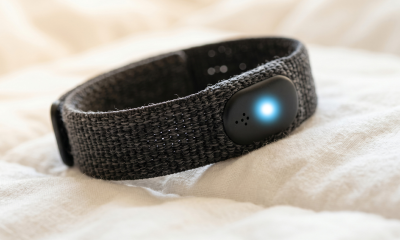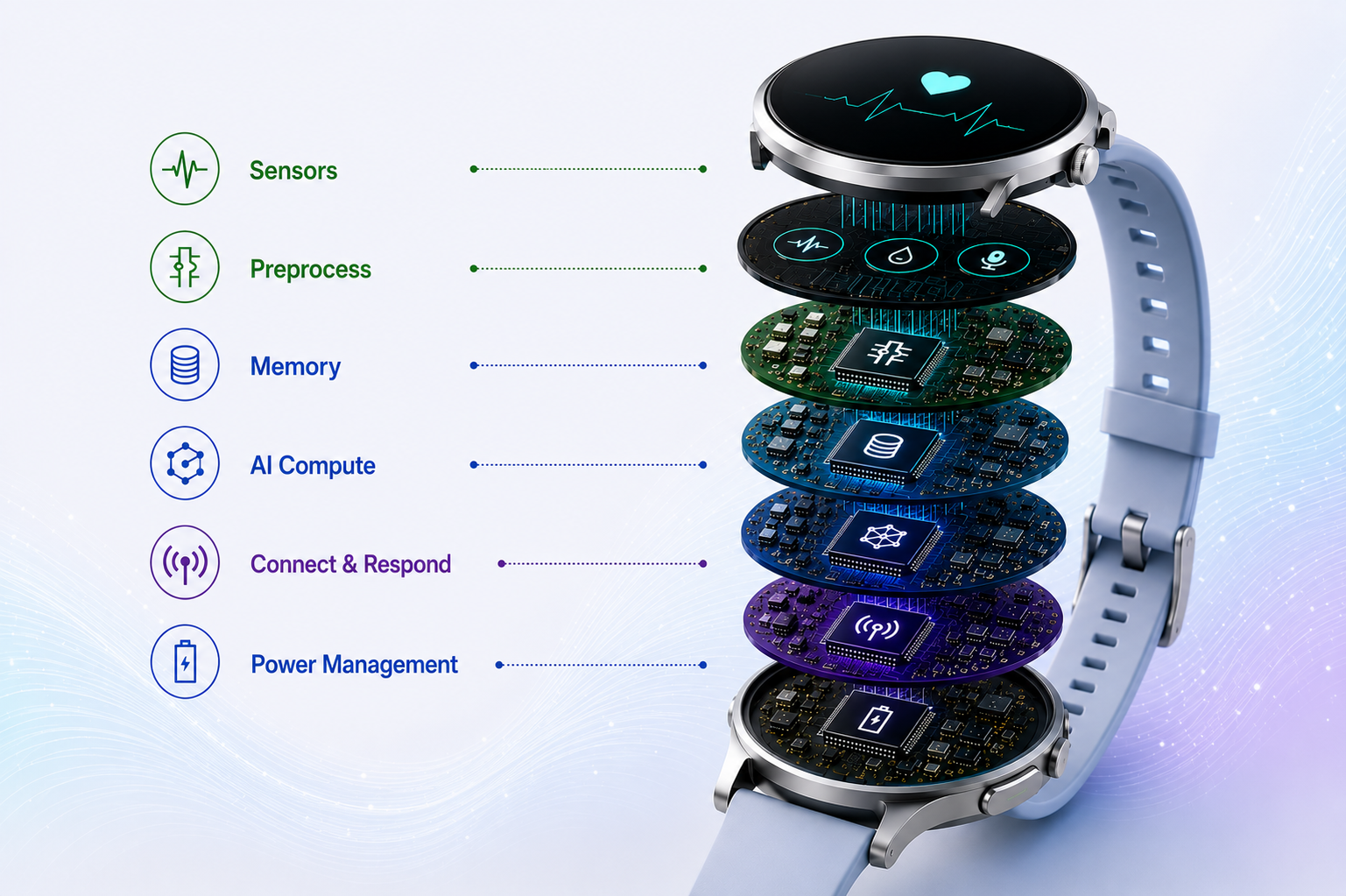
Wearables are becoming smarter, but their batteries aren’t increasing in size proportionally.
From health monitoring and activity recognition to always-on voice and emerging AI assistants, wearable devices are increasingly expected to sense, interpret, and respond to the world around them in real time. More of that intelligence is also moving onto the device, reducing reliance on cloud connectivity while improving responsiveness and privacy.
But every additional workload competes for the same limited energy budget.
That changes how product and engineering teams should evaluate edge AI chips for ultra-low-power wearables. Peak AI performance matters, but it is only one factor. For a battery-powered device, the more relevant question is:
How much intelligence can the system deliver within its available power budget?
When evaluating edge AI chips for ultra-low power wearables, prioritize total system power, energy-efficient compute aligned with the workload, memory and data-movement efficiency, dynamic power scaling, always-on sensing, and an AI software stack that makes the hardware practical to deploy. Peak AI performance alone doesn’t determine battery life.
1. Look Beyond TOPS to Total System Power
AI processors are often compared using peak performance metrics such as TOPS or GOPS. These numbers can help characterize compute capability, but they don’t necessarily reflect how a wearable device operates.
Most wearables aren’t running their most demanding AI workload continuously.
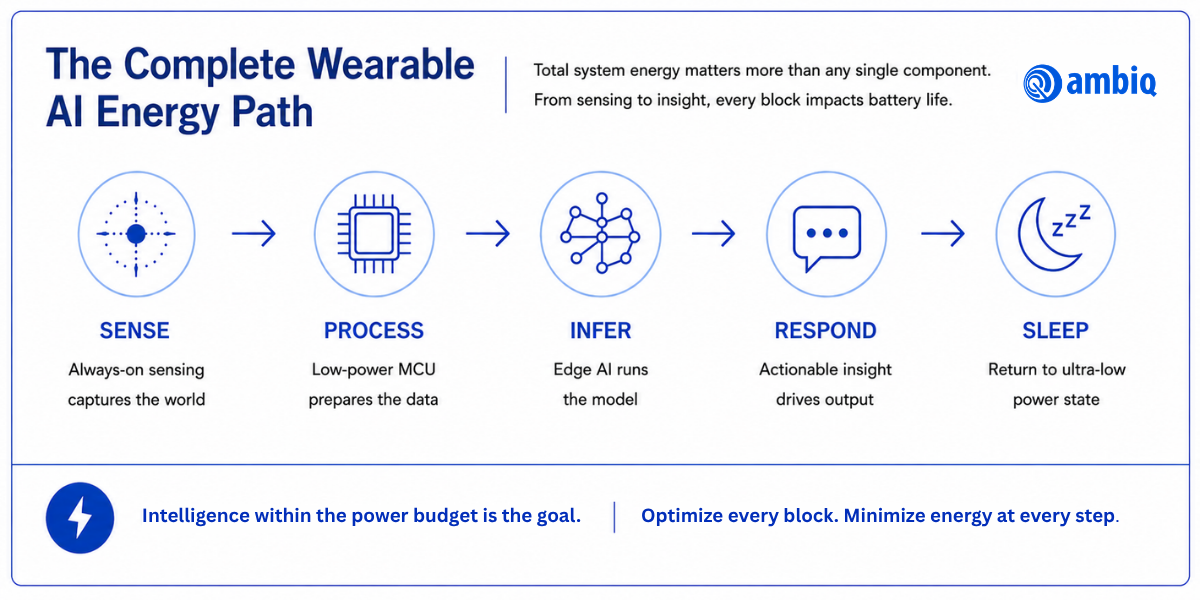
A device may spend much of its life monitoring sensors at extremely low power, periodically waking to process data, running an inference when something meaningful occurs, communicating the result, and then returning to a low-power state.
That makes the energy consumed over the entire operating cycle more important than an isolated accelerator benchmark.
When comparing edge AI hardware, product teams should consider how efficiently the system handles the following:
- Always-on sensing
- Signal preprocessing
- Memory access and data movement
- AI inference
- Connectivity
- Transitions between low-power and high-performance states
The objective isn’t simply to minimize inference power. It’s to minimize total system energy while still delivering the required user experience.
That system-level approach is central to Ambiq’s SPOT® (Subthreshold Power Optimized Technology) platform. Rather than treating low power as an optimization applied to individual workloads, SPOT is designed to reduce energy consumption at the semiconductor level across all functions required by intelligent endpoint devices.
For wearable designers, the distinction matters. AI energy efficiency starts with the architecture beneath the AI.
2. Match the AI Hardware to the Workload
Dedicated neural processing can significantly accelerate AI workloads. But that doesn’t mean every wearable AI application needs an NPU running all the time—or even needs one at all.
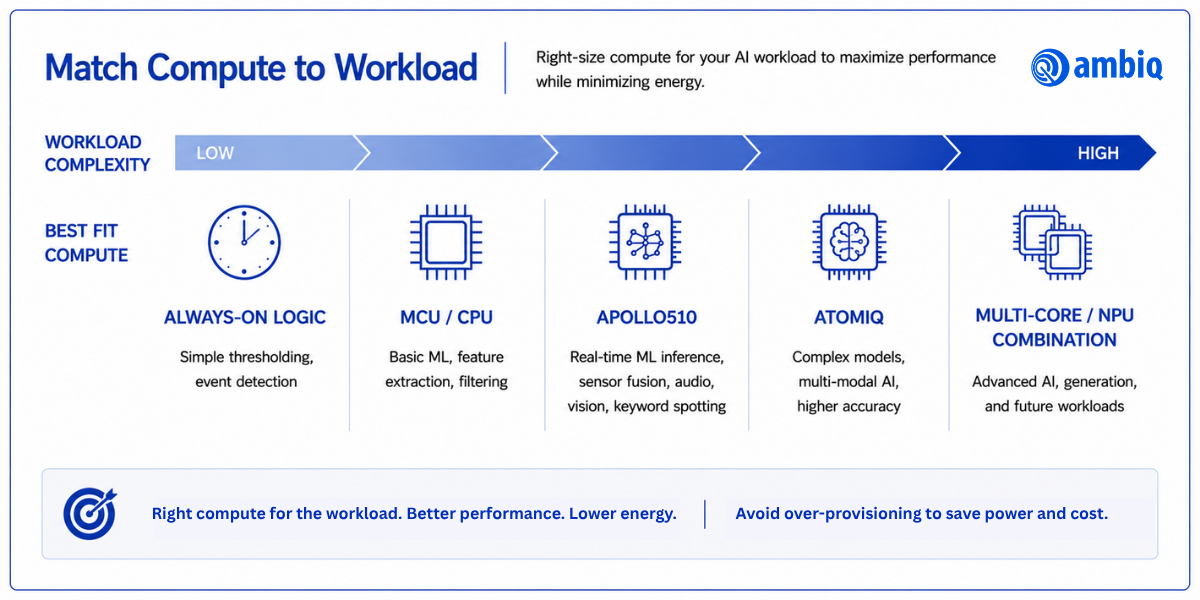
Many always-on applications involve relatively compact workloads: sensor classification, keyword detection, motion recognition, anomaly detection, and other forms of continuous monitoring.
For these applications, the better question isn’t:
Does this chip have an NPU?
It’s:
What is the most energy-efficient compute resource for this particular workload?
That means evaluating the entire compute architecture rather than focusing on a single accelerator.
Ambiq’s Apollo510 exemplifies this approach. Built around an Arm® Cortex®-M55 processor with Helium™ technology and Ambiq’s SPOT platform, Apollo510 is designed to run a broad range of AI workloads without a dedicated NPU, including low-power sensor monitoring and always-on voice applications.
For product teams, matching the compute architecture to the workload can help avoid wasting energy and silicon resources on performance the application doesn’t require.
As models become more demanding, dedicated AI acceleration becomes increasingly valuable. The architecture therefore needs a path to scale effectively.
3. Look at How Power Scales With the Workload
Wearable computing is inherently dynamic. A device might need very little power while monitoring an input, considerably more when processing an event, and yet another level of performance when executing a complex AI workload.
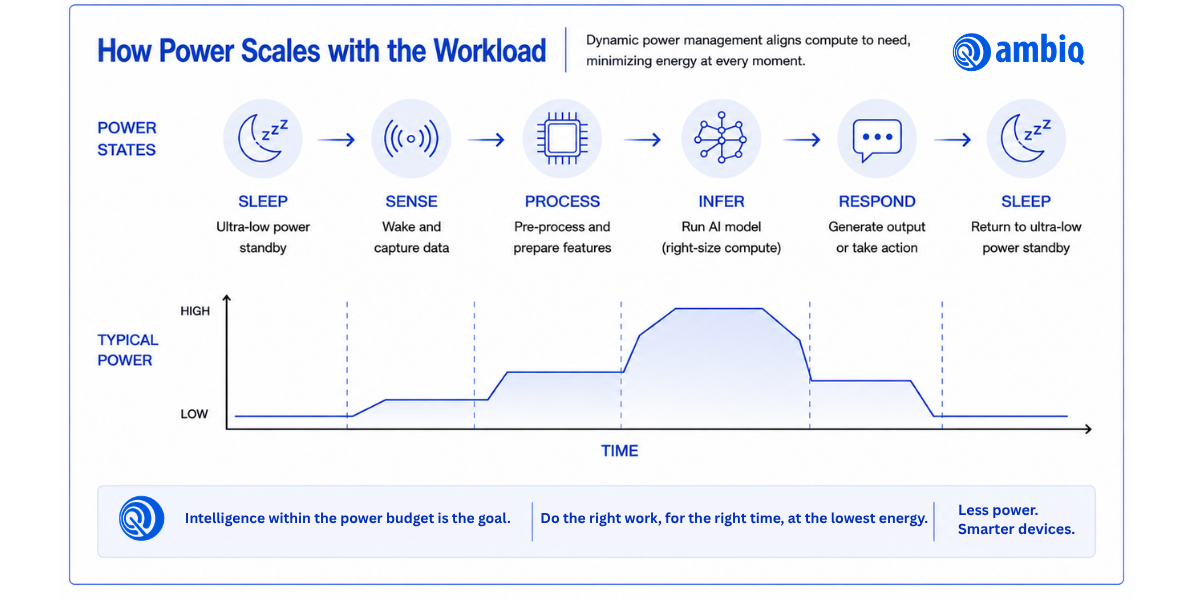
An architecture optimized around a single operating point can be inefficient across those transitions.
For ultra-low-power wearables, hardware should be able to match performance—and therefore energy consumption—to the workload.
Ambiq’s SPOT architecture is built around this principle. Technologies such as turboSPOT® enable higher processing performance when workloads demand it while maintaining an architecture designed for ultra-low-power operation. This principle becomes even more important as wearable AI workloads expand.
Ambiq’s next-generation Atomiq™ architecture extends its ultra-low-power approach to dedicated neural processing. Atomiq combines SPOT technology with an Arm® Ethos™-U85 NPU, delivering more than 200 GOPS of AI performance. Its dynamic voltage and frequency scaling architecture is designed to span ultra-low-power, low-power, and high-performance operating modes, including an ultra-low-power mode engineered for operation near 300 mV.
The important point isn’t simply that a processor can operate quickly or at very low power consumption.
It’s whether the architecture can efficiently move between those operating points as the workload changes.
For always-on AI, those transitions can be as important to battery life as the efficiency of the inference itself.
4. Don’t Overlook Memory and Data Movement
Compute gets much of the attention in discussions of AI chip energy efficiency. But performing an operation is only part of the energy equation. The data has to get there.
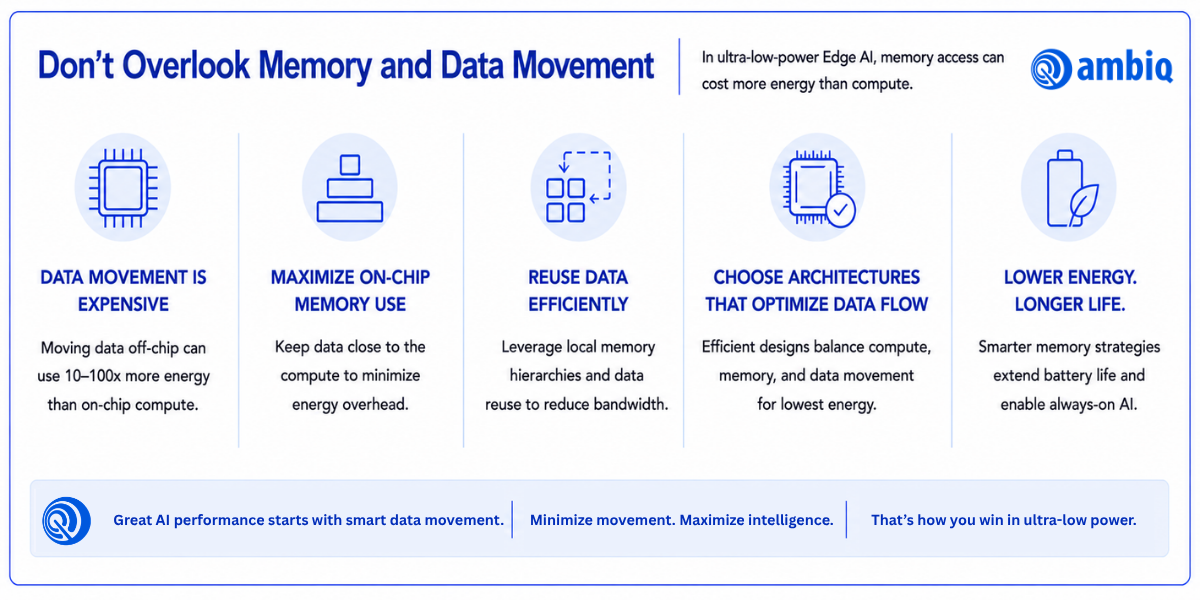
Model weights, sensor inputs, intermediate activations, and application data continually move between memory and compute resources. Those transfers consume energy. If the memory architecture is inefficient, data movement can erode some of the gains delivered by specialized AI processing.
Product and engineering teams should therefore look beyond compute specifications and examine:
- Available on-chip memory
- Memory bandwidth
- Model and weight storage
- Data retention
- Memory access patterns
- Proximity of memory to compute resources
The larger and more sophisticated the model becomes, the more important these considerations become.
This is especially relevant for wearable devices because adding external memory may increase power consumption, cost, board space, and system complexity.
Efficient on-device AI is therefore not only about performing computation efficiently. It is also about reducing the amount of energy required to move and store the data that computation depends on.
5. Design Always-On Sensing Into the AI Architecture
Many wearable AI experiences begin long before a neural network runs.
A device may continuously monitor motion, audio, physiological signals, environmental inputs, or other sensor streams while awaiting something meaningful to occur.
Running the highest-performance processing resource continuously for these tasks can quickly erode the battery-life advantages of edge AI.
Instead, an ultra-low-power architecture should enable the device to keep only the resources required for a specific task active.
Lightweight sensing and processing can run while higher-performance compute remains in a lower-power state. When an event requires more sophisticated processing, the system can activate additional resources, perform the work, and then return to a lower-power mode.
This hierarchical approach is particularly important for wearable computing because always-on does not have to mean operating at maximum performance.
The ability to perform useful work at very low power—and selectively scale compute when needed—is fundamental to making continuous intelligence practical for small, battery-powered devices.
6. Evaluate the Hardware and Software Together
Efficient silicon creates value only if developers can use its capabilities effectively.
Edge AI deployment involves more than simply getting a neural network to run. Engineering teams need to convert models, optimize them for constrained hardware, profile performance and memory usage, integrate real sensor pipelines, and understand where the system consumes energy.
The AI software stack should therefore be included in the silicon evaluation from the beginning.
Ambiq’s neuralSPOT® SDK is designed around this hardware-software relationship. It provides an open-source, real-time, OS-agnostic environment for developing, deploying, tuning, and profiling AI models on Apollo SoCs.
For engineering teams, this can help shorten the path from a model running in a development environment to an optimized implementation on an ultra-low-power endpoint.
It also enables a capability increasingly important in edge AI: co-optimization.
Instead of optimizing the model and silicon separately, developers can evaluate how model architecture, quantization, memory utilization, processing resources, and operating modes interact on the target hardware.
In a highly constrained wearable, those interactions matter.
A small change in model architecture or memory behavior may have a greater impact on overall energy consumption than a headline increase in peak AI performance.
7. Choose an Architecture That Can Scale With Edge AI
Wearable AI requirements are rapidly evolving.
Today’s device might require activity classification or keyword detection. Tomorrow’s device could combine multiple sensors with richer audio processing, computer vision, natural-language interfaces, or increasingly capable on-device AI models.
That doesn’t mean every product should start with the largest available AI accelerator. It means the underlying platform needs room to scale.
Ambiq’s portfolio illustrates this progression.
Apollo SoCs provide an ultra-low-power foundation for embedded and edge AI workloads. Apollo510 extends that capability with higher-performance processing for increasingly sophisticated AI, without requiring an NPU in many applications.
For workloads that benefit from substantially greater dedicated neural processing, Ambiq’s upcoming Atomiq family extends the architecture, adding NPU acceleration while retaining SPOT as its ultra-low-power foundation.
This creates a continuum rather than a one-size-fits-all approach to edge AI compute.
For wearable designers, that makes it possible to select an architecture based on what the application actually requires rather than automatically paying the power and system costs for performance it rarely uses.
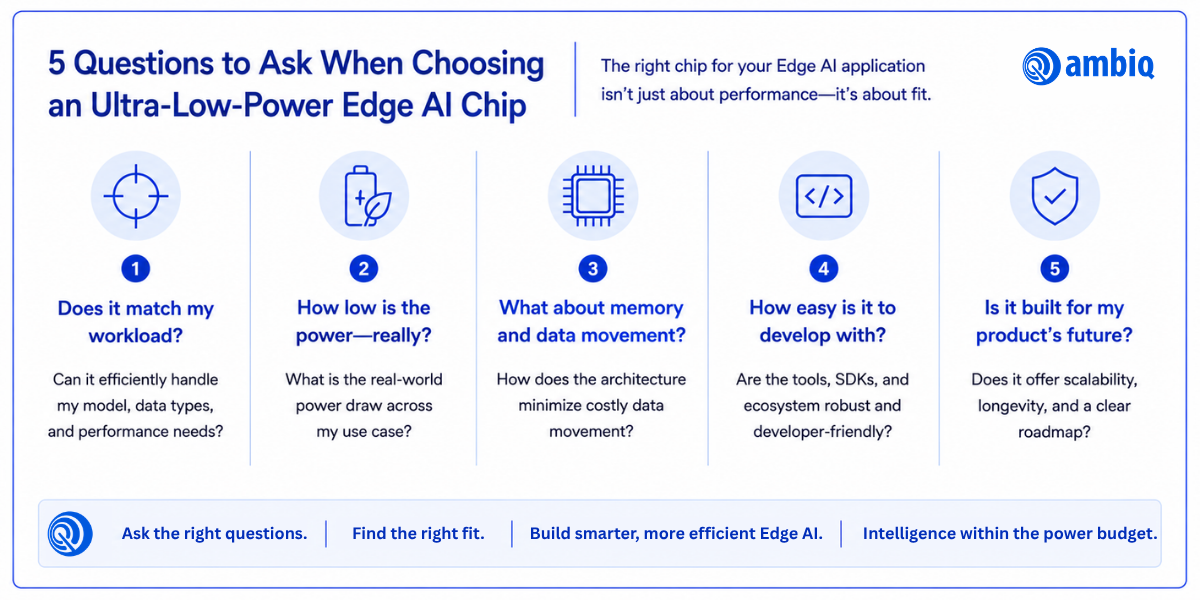
Questions to Ask When Comparing Edge AI Chips for Wearables
Specifications are useful for creating a shortlist, but product and engineering teams should go beyond them when evaluating edge AI chips for ultra-low-power wearables.
The goal is to understand how each architecture will behave under the conditions the actual device will face.
What Is the Energy Cost of the Complete Workload?
Ask vendors for measurements that account for sensing, preprocessing, memory access, AI inference, post-processing, and transitions between operating states.
An impressive accelerator benchmark doesn’t necessarily translate into lower overall wearable device power consumption.
The relevant question is how much energy the entire application consumes over its actual duty cycle.
Does the Application Actually Require an NPU?
An NPU can be highly effective for sufficiently demanding neural-network workloads. However, adding or activating specialized compute when it isn’t required can introduce unnecessary system complexity.
Evaluate which workloads can run efficiently on the CPU or other available compute resources, and where dedicated neural processing delivers a meaningful performance or energy advantage.
For wearable AI, the answer should be determined by the workload rather than by the presence of an accelerator in the specification sheet.
How Efficiently Does the Architecture Move Between Power States?
Wearables rarely operate continuously at peak performance.
Ask how quickly and efficiently the processor can boost performance when needed and return to a lower-power state when the task is complete.
For an always-on device, energy consumed during these transitions can affect the overall battery budget.
How Much Energy Is Spent Moving and Storing Data?
AI benchmarks can emphasize computation while neglecting memory.
Ask how model weights, sensor data, and intermediate results flow through the system and whether frequently used data can remain close to the processing resources that need it.
As models grow, memory architecture and data movement can become increasingly significant contributors to total AI energy consumption.
Can Developers Test and Profile Actual Models on the Hardware?
Representative workloads provide more useful information than generic benchmarks do.
Engineering teams should be able to evaluate model latency, memory utilization, compute utilization, and power behavior using models and sensor pipelines that mirror the intended product.
The closer the benchmark is to the final application, the more meaningful the results are.
Can the Platform Scale as AI Requirements Change?
Today’s wearables may require sensor classification or keyword detection. Future generations may add multimodal sensing, richer audio and vision, natural-language interfaces, or more advanced on-device models.
Ask whether the architecture offers a practical path to improved AI performance without abandoning the energy-efficiency principles that made the device viable in the first place.
Together, these questions shift the comparison from:
Which chip has the biggest AI number?
to:
Which architecture can run my application most efficiently?
For ultra-low-power wearable AI, that is the more relevant comparison.
Test the Workload, Not Just the Benchmark
Specification sheets should narrow the list of potential chips. Real-world workloads should determine the choice.
Before selecting an edge AI platform, test it with representative models, sensor inputs, sampling rates, memory requirements, and operating patterns.
Measure the complete path:
Sense → Preprocess → Move Data → Infer → Respond → Sleep
That provides a more realistic view of wearable device power consumption than measuring inference latency or accelerator power in isolation.
It can also expose bottlenecks that aren’t apparent from a data sheet.
An accelerator might execute a neural network extremely efficiently, while preprocessing, memory transfers, or system wake time account for a significant share of the total energy consumed.
The best architecture is therefore not necessarily the one that wins an isolated AI benchmark.
It’s the one that performs the complete application workload most efficiently.
The Real Benchmark: Intelligence Within the Power Budget
The next generation of wearables won’t be defined solely by how much AI compute engineers can fit on the wrist, finger, ear, or body.
It will be defined by how much useful intelligence they can deliver with a finite amount of energy.
That makes total system power, workload-aware compute, efficient memory movement, always-on sensing, dynamic performance scaling, and hardware-software co-optimization critical considerations when selecting edge AI chips for ultra-low power wearables.
Ambiq approaches this problem from the power architecture up.
Its SPOT platform provides the ultra-low-power foundation. Apollo brings that efficiency to wearable-class edge computing. neuralSPOT gives developers the tools to build and optimize AI workloads for the hardware. As models require greater dedicated AI performance, Atomiq extends the same ultra-low-power philosophy into an NPU-based architecture.
For wearable products and engineering teams, the key takeaway is straightforward:
Don’t start by asking how much AI performance a chip can deliver. Start with the device’s energy budget—and ask how much intelligence the architecture can deliver within it.
For always-on, battery-powered edge AI, that’s the benchmark that counts.