Some of the most innovative designs changing healthcare, fitness, and industrial edge have no displays—and that’s a deliberate engineering choice.
When we picture a “smart” device, we instinctively picture a screen. A glowing rectangle delivering notifications, graphs, and menus. It’s an assumption so deeply baked into consumer tech that we rarely question it.
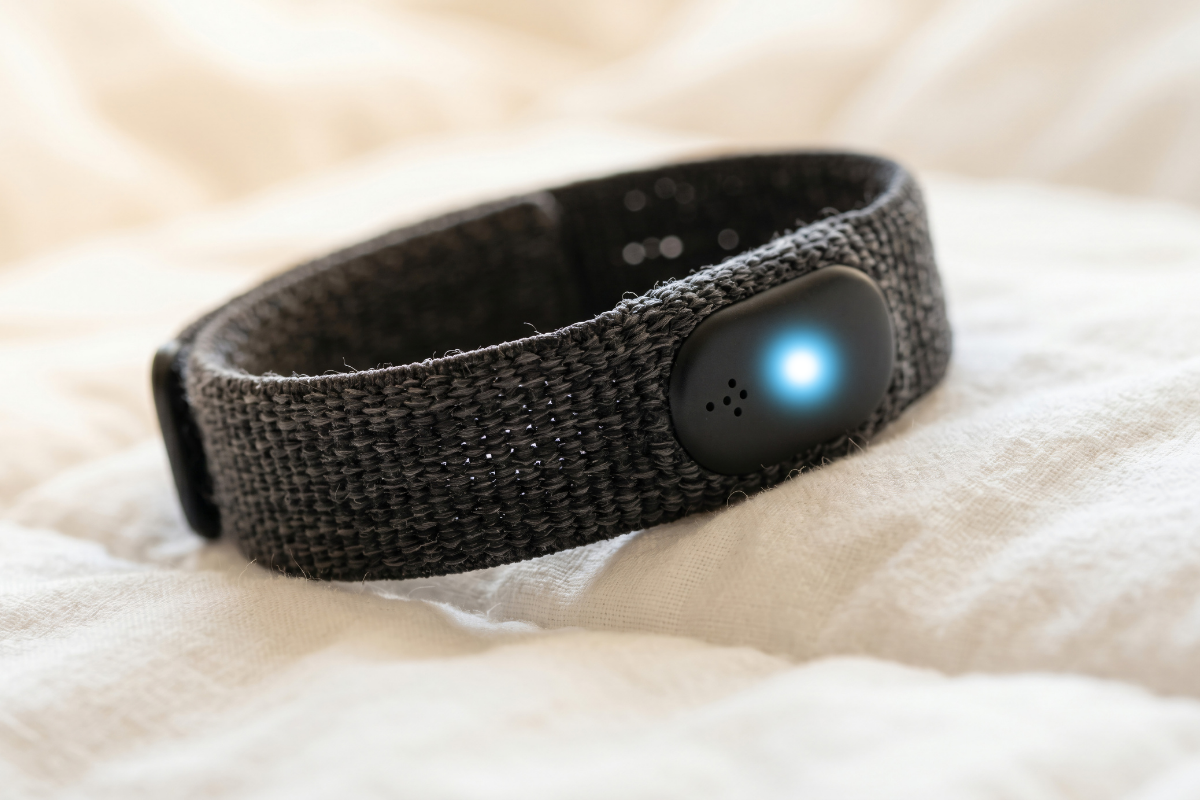
But some of the most consequential AI-powered devices shipping today have no display at all yet still pack powerful intelligent features.
The Oura Ring tracks sleep stages, body temperature, and heart rate variability continuously throughout the day and night. The WHOOP strap monitors strain and recovery around the clock, including during swims and contact sports. Google recently revealed its screenless take with the Fitbit Air, an activity tracking band that lasts for up to a week on a single charge with integration for their AI health coach.
Beyond wearables, cochlear implants and next-generation hearing aids perform real-time audio signal processing directly on the device. Industrial vibration sensors embedded in factory equipment detect mechanical failures before they happen. Environmental monitoring systems continuously analyze air quality and infrastructure conditions at the edge.
What makes these products notable is not simply that they lack screens. They represent a broader shift in how intelligent devices are being designed.
As AI moves from the cloud to the edge, manufacturers are increasingly prioritizing always-on sensing, longer battery life, and unobtrusive form factors over display-driven experiences. For investors and technology leaders, this shift signals the emergence of a rapidly growing class of products built around ultra-low-power edge AI.
Each of these devices runs sustained AI inference at the edge, making intelligent, real-time decisions without a cloud connection, a display, or a battery that needs daily charging.
Screenless devices are not a stripped-down version of AI. Rather, they fit a different set of engineering challenges entirely.
Why Screenless AI Devices Are Gaining Adoption
Removing the display from a device isn’t a cost-cutting move, but rather a design philosophy driven by the workload.
Why Screens Drain Battery Life in Always-On Devices
Displays can consume more energy than the rest of a device’s components combined. For continuously monitoring digital health devices and always-on sensors, this can become a limiting factor. Daily charging can lead to lapses in collecting important data or become impractical for a factory running industrial monitoring at scale.
Users want these technologies to fade into the background. They want confidence that the device is working, collecting data, and delivering meaningful insights when needed.
Screens also demand attention. A ring, a patch, or a clip-on sensor that silently monitors the environment or the human body and provides insights only when needed will draw far less power than a device that simultaneously manages phone calls, text messages, GPS, music, payments, and health monitoring.
These screenless devices work because they handle a dedicated set of user problems both intelligently and energy efficiently.
How Screenless Design Unlocks New Form Factors
Displays also impose form-factor constraints. An Oura Ring works well because it sits comfortably on a finger. A cardiac monitoring patch works because it conforms to the skin. A hearing aid works because it remains nearly invisible to the user. The moment a display is introduced, designers face new constraints on shape, size, weight, thermal management, and battery capacity. For many use cases in healthcare, industry, and the environment, this is non-negotiable.
None of this is an argument against displaysSmartwatches, medical tablets, and connected industrial terminals have their own demanding requirements, and delivering rich graphics and user interfaces at ultra-low power remains a significant engineering challenge. Ambiq addresses those applications as well through its graphics-focused solutions, including graphiqSPOT™ technology. The design goals, however, are fundamentally different, purpose-built. The screenless device is optimized to solve a more focused set of challenges.

Why Edge AI Requires a Different Approach to Compute
The instinct in AI hardware is to reach for more: more compute, more memory, more headroom. That instinct makes sense when the product is a phone, a laptop, or a cloud server. Rendering graphics, managing a full operating system, and running AI inference simultaneously requires substantial computational resources.
But edge devices operate under strict constraints; every milliwatt, every clock cycle, and every byte of memory has a cost.
Models trained in the cloud assume abundant compute. Shrinking them for deployment on a constrained edge device without sacrificing accuracy requires an entirely different approach — purpose-built silicon, optimized inference engines, and a software stack that understands the hardware at a deep level.
Raw power becomes a secondary concern while precision is at the forefront. The goal is to deliver exactly the compute a workload requires at the lowest possible energy cost, while sustaining it indefinitely.
This challenge sits at the center of many emerging product categories, from wearable health monitors and hearing aids to industrial sensors and environmental monitoring systems.
How Ambiq Powers Screenless Edge AI Devices
The rise of screenless AI devices highlights a fundamental challenge: delivering meaningful intelligence within extremely constrained power budgets.
Ambiq’s patented SPOT® (Subthreshold Power Optimized Technology) platform was built for the challenges of screenless edge devices
The Apollo family of SoCs uses SPOT to operate circuits in the subthreshold region, where transistors consume a fraction of the power of conventional designs. This approach helps enable advanced on-device intelligence for weeks, months, or even years of operation depending on the application.
For screenless, display-free applications, the Apollo330 Plus SoC series delivers a purpose-built package optimized for sustained AI inference at ultra-low power levels, enabling always-on intelligence without always-on battery drain.
Whether the application is a wearable health monitor, a hearing aid, an industrial sensor, or an environmental monitoring device, the objective remains the same: maximize useful intelligence while minimizing energy consumption.
The Future of Wearable AI and Screenless Edge Devices
The screenless revolution is early. The devices that will define it over the next five to ten years are still being designed.
Continuous glucose monitoring without a fingerstick. Smart hearing aids that suppress noise and translate languages in real time. Environmental sensors that detect air quality, chemical exposure, or structural stress with no cloud dependency. Patches that monitor chronic conditions passively, flagging anomalies before symptoms appear.
None of these applications requires a screen. All of them require intelligence — sustained, efficient, and precisely matched to the task.
The shift underway isn’t just about making devices smaller or cheaper. It’s a fundamental rethinking of what “smart” means. Smart doesn’t have to mean visible. It doesn’t have to mean connected to the cloud. It doesn’t have to mean a battery charged every night.
Smart can mean a ring that knows your body better than you do. A sensor that catches failure before it happens. A device so unobtrusive you forget you’re wearing it — until it tells you something important.
That’s the promise of right-sized AI at the edge. And it’s being built on platforms like SPOT, running on a core engineering principle: give every workload exactly the intelligence it needs, at the lowest possible cost to power it.
Interested in building for always-on edge devices? Learn more at ambiq.com.