
bg mobile chip
bg desktop chipApollo kv desktop 1 scaled

Apollo Ultra-Low Power SoC Platform for IoT Devices

SPOT on a Chip
apollo kv mobile 1

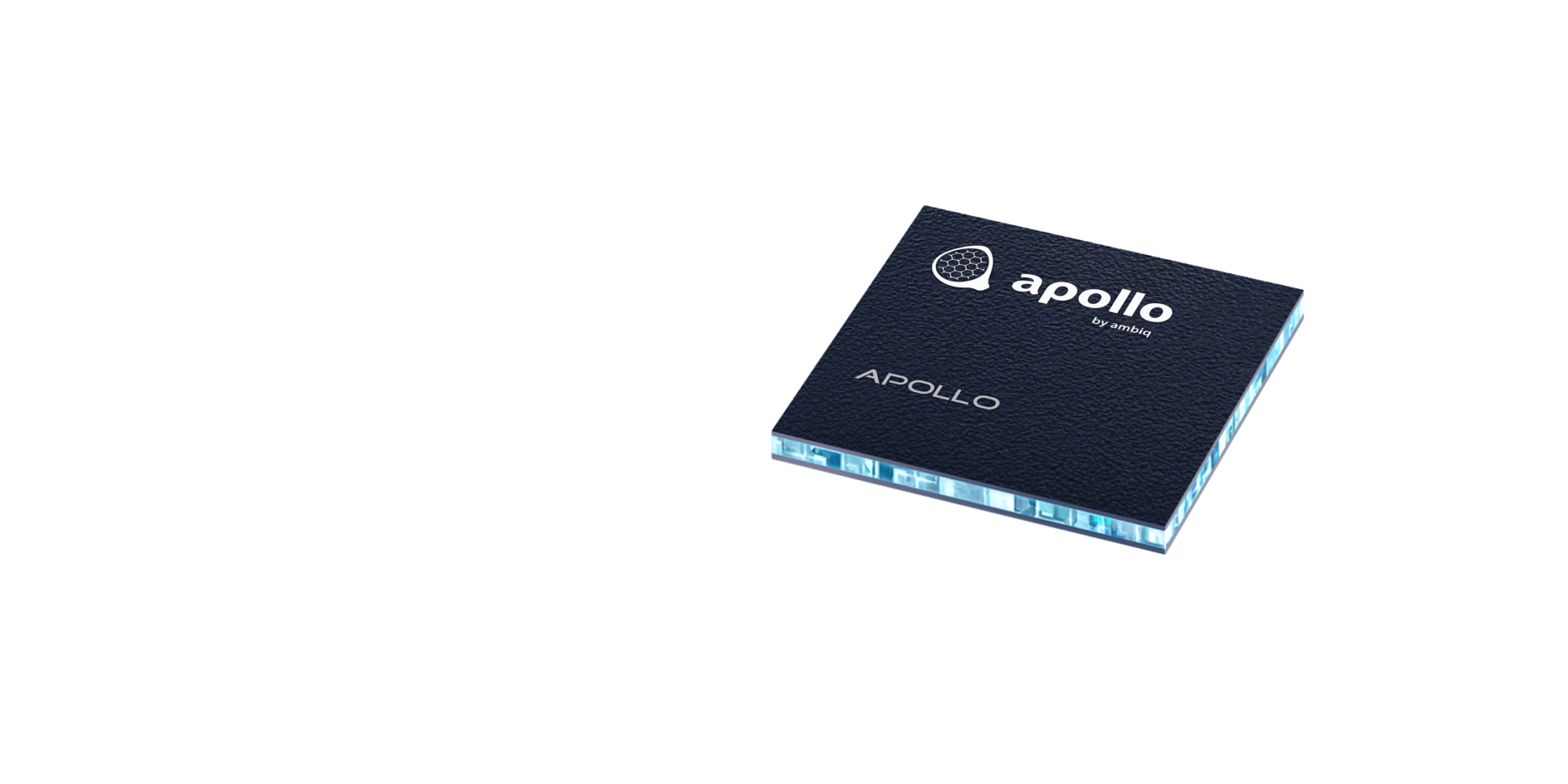
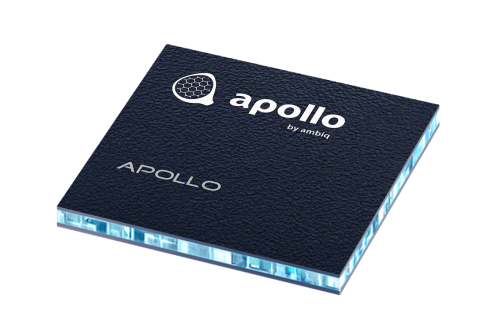
The first generation* of Ambiq’s Apollo SoC introduced the ultra-low power Subthreshold Power Optimized Technology (SPOT®) platform, the first to bring subthreshold technology into mass production, delivering revolutionary battery life for smart devices, including wearables, activity and fitness monitors, and wireless sensors.


*The first-gen Apollo SoC is not recommended for new designs. Apollo2 or Apollo3 instead.
Take Charge of Your Life

01

Extended Battery Life:

The SPOT platform can extend the battery life of devices to last weeks or months.

02

Uniquely Tuned ADC

ADC is uniquely tuned for minimum power with a configurable measurement mode that does not require SoC intervention.

03

High Performance

Implementing the Arm® Cortex®-M4 with FPU provides higher performance and significantly lower power consumption than 8-bit, 16-bit, and other comparable 32-bit cores.

04

Process Sensor Data

Capable of running complex data analysis and sensor fusion algorithms on device.

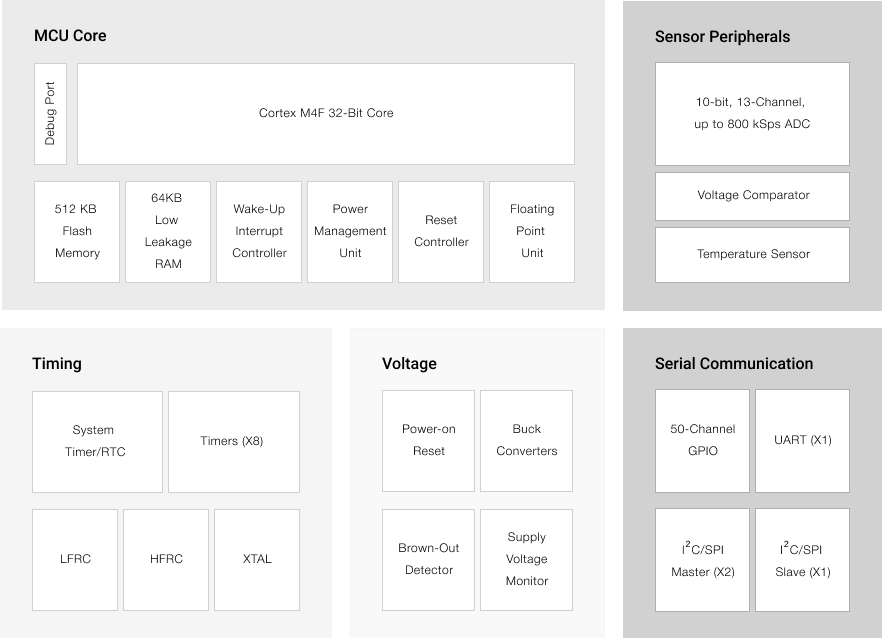
Block Diagram for the Apollo Ultra-Low Power SoC

Block Diagram for the Apollo MCU

Specifications

Ultra-Low Supply Current

  • EEMBC ULP Bench score of 377
  • 35 μA/MHz executing from flash at 3.3 V
  • 143 nA deep sleep mode at 3.3 V
  • 419 nA deep sleep mode with XTAL-assisted RTC at 3.3 V

High-Performance Arm Cortex-M4 Processor

  • Up to 24 MHz clock frequency
  • Floating Point Unit (FPU)
  • Memory Protection Unit (MPU)
  • Wake-up interrupt controller with 12 interrupts

Ultra-low Power Memory

  • Up to 512KB of flash memory for code/data
  • Up to 64KB of low-power RAM for code/data

Ultra-Low Power Interface for On- and Off-Chip Sensors

  • 10-bit, 13-channel up to 800 kSps ADC
  • Up to 800 kSps sampling rate
  • Temperature sensor with ±4°C accuracy

Ultra-Low Power Flexible Serial Peripherals

  • 2xl2C/SPI masters for communication with sensors, radios, and other peripherals
  • 1xl2C/SPI slave for host communications
  • 1x UART for communication with peripherals and legacy devices

Rich Set of Clock Sources

  • 32.768 kHz Crystal (XTAL) oscillators
  • Low Frequency RC (LFRC) oscillator (1.024 kHz)
  • High Frequency RC (HFRC) oscillator (24 MHz
  • RTC based on Ambiq’s AM08X5/18X5 family

Wide Operating Range

  • 1.8-3.8 V, -40°C to 85°C

Applications

  • Wearable electronics
  • Wireless sensors
  • Activity and fitness monitors
  • Consumer medical devices

Package Options

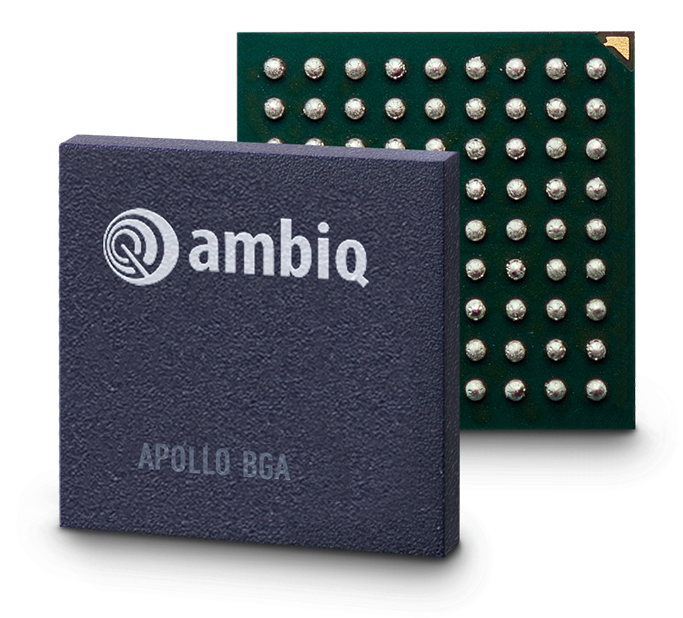
  • 4.5 mm x 4.5 mm 64-pin BGA with 50 GPIO
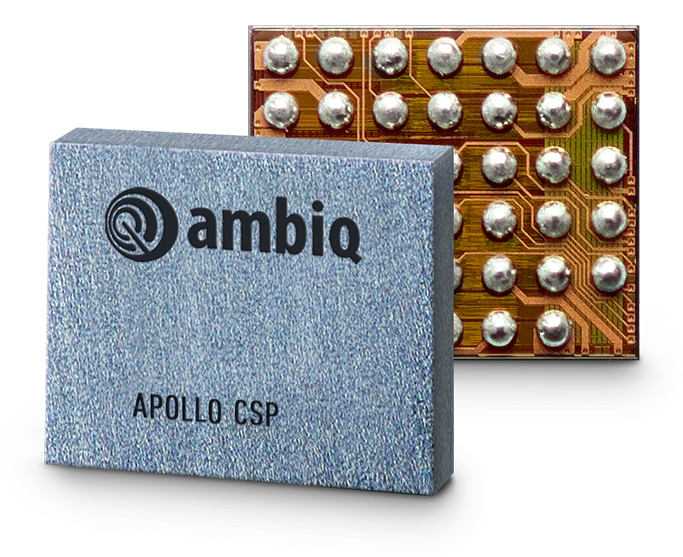
  • 2.49 mm x 2.90 mm 41-pin WLCSP with 27 GPIO

Ordering Information

  • APOLLO512-KBR (512KB Flash, 64KB RAM, 64-pin BGA)
  • APOLLO512-KCR (512KB Flash, 64KB RAM, 41-pin WLCSP) AMAP1EVB (EVB)

Where to Buy

Apollo SoC BGA APOLLO512-KBR

APOLLO512-KBR

Apollo BGA
Apollo SoC WLCSP APOLLO512-KCR

APOLLO512-KCR

Apollo WLCSP

Design Resources

Additional Documentation

  • Set favorites
  • Get update notifications
  • Use search filters

Video Library

hqdefault
hqdefault
hqdefault

Frequently Asked Questions (FAQ)

  • Apollo is a family of ultra-low-power system on chips (SoCs) developed by Ambiq for battery-powered devices such as wearables, IoT sensors, and wireless embedded systems.

  • Apollo SoCs use the Arm® Cortex®-M4 architecture as well as M55 depending on Apollo generation, providing efficient embedded processing with floating-point support for sensor processing and signal analysis.

  • Apollo SoCs use Ambiq’s SPOT® (Subthreshold Power Optimized Technology) platform, which allows the transistiors to operate at extremely low voltages and reduce power consumption.

  • Apollo SoCs are commonly used in wearables, fitness trackers, smart home devices, industrial sensors, healthcare monitoring systems, and battery-powered IoT devices.

  • Yes. Apollo SoCs include analog and digital sensor interfaces that allow devices to process accelerometer, gyroscope, and other sensor data efficiently.

  • Wearable devices require processors that consume minimal power to extend battery life while maintaining reliable performance for continuous monitoring and data processing.

  • Yes. Apollo SoCs can support lightweight edge AI workloads such as activity recognition, voice commands, and sensor data analytics.

  • Ambiq provides software development kits, documentation, and developer tools to help engineers build applications using the Apollo SoC platform.

Preparing to download