Zephyr-based integration enables Apollo510 and Apollo330M Plus devices to support coordinated robotics and industrial sensing without a central controller
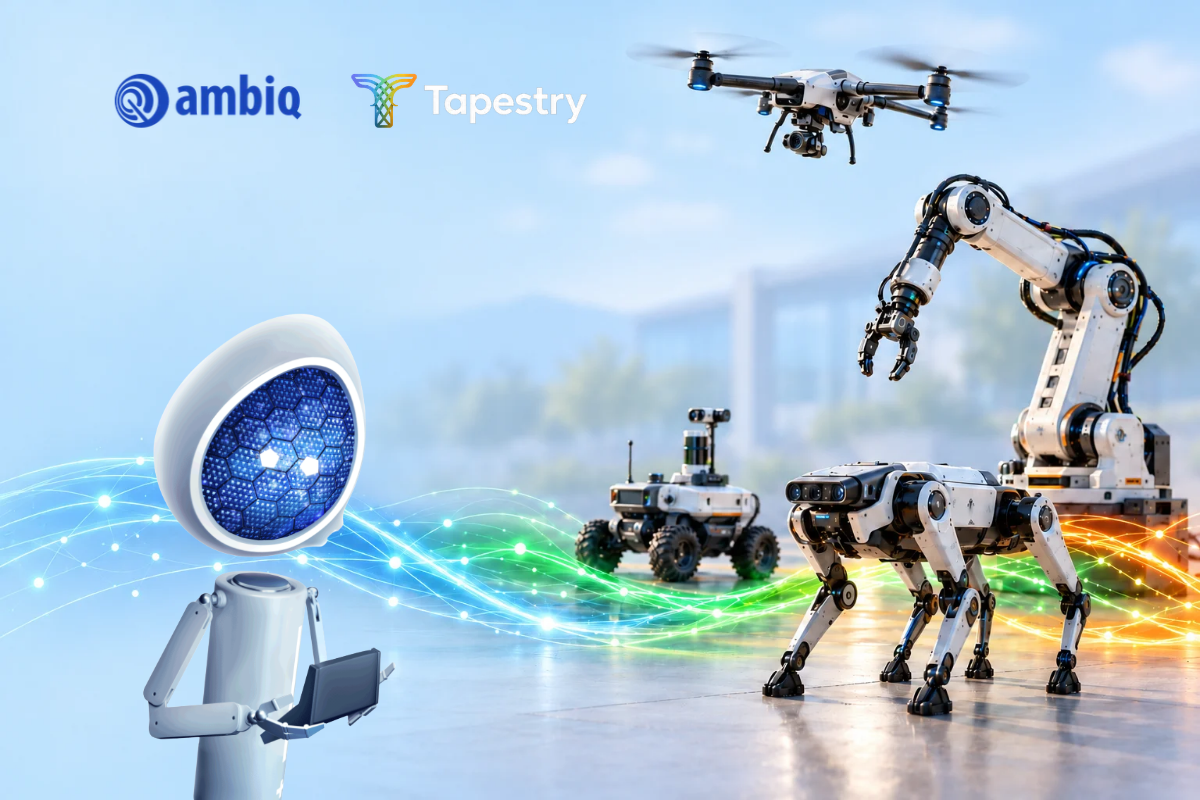
AUSTIN, TX, October 26, 2026, Ambiq Micro, Inc. (“Ambiq®”) (NYSE: AMBQ), a technology leader in ultra-low power semiconductor solutions for edge AI, and Tapestry OS today announced that Tapestry’s open-source software for decentralized device coordination now runs on Ambiq’s Apollo510 and Apollo330M Plus systems-on-chip (SoCs). Through Ambiq’s expanded Zephyr RTOS support, the integration enables battery-powered sensors and robots to share information and coordinate actions locally, without relying on a central controller or cloud connection.
The integration combines Ambiq’s energy-efficient compute with Tapestry’s decentralized coordination software, providing manufacturers with a foundation for developing groups of intelligent devices that work together within tight power budgets. Potential applications include industrial sensor networks that share information about facility conditions and mobile robots that coordinate their responses to changes in their surroundings.
From individual devices to coordinated systems
Physical AI applications in robotics and industrial sensing require devices to sense their surroundings, process information, and respond to changing conditions. When multiple devices work together, manufacturers must also manage communication, shared information, and group behavior within the system’s energy budget.
Ambiq’s Apollo SoCs, built on its patented Subthreshold Power Optimized Technology (SPOT®) platform, provide ultra-low-power processing for sensing and on-device AI. Tapestry lets these devices share state and coordinate behavior through peer-to-peer communication over Bluetooth® Low Energy, without centralized control or cloud connectivity.
With Tapestry OS, engineering teams building industrial sensors and robots can define how groups of devices should work together, while the software manages information sharing and coordination across participating devices. This reduces the need to build custom coordination software, making it easier for manufacturers to develop distributed sensing and robotics systems that adapt to changing conditions.
Demonstrating the value of the Zephyr ecosystem
Tapestry OS’s initial bring-up on the Apollo platforms took less than a day and required no changes to its coordination layers. The integration demonstrates how Ambiq’s expanded Zephyr support can reduce porting effort and make advanced software more accessible to developers building on ultra-low-power silicon.
By reducing porting effort, the integration makes it easier for manufacturers to evaluate Apollo for coordinated sensing and robotics, extending the platform’s reach into industrial and emerging physical AI applications.
“Power efficiency and software accessibility are both essential to bringing intelligence into more physical devices,” said Scott Hanson, Founder and CTO of Ambiq. “Tapestry adds the ability for those devices to work together. Its rapid bring-up on Apollo demonstrates how our investment in Zephyr helps developers build on our platform and explore new applications in industrial sensing and robotics.”
“Developers should be able to describe what a group of devices needs to accomplish without rebuilding the coordination software for every application,” said Jim Steele, Founder of Tapestry OS. “Combining Tapestry with Ambiq’s ultra-low-power processing gives them a foundation for bringing that approach to battery-powered sensors and robots.”
At DARS 2026, the International Symposium on Distributed Autonomous Robotic Systems, October 26–29 in Tokyo, Tapestry OS plans to demonstrate ground robots collectively locating and surrounding a leak. If one robot loses power, the remaining robots reposition to maintain coverage. The demonstration will illustrate how the group adapts when an individual robot becomes unavailable, without instructions from a central controller.
Availability
Tapestry OS is available as open-source software under the Apache 2.0 license, with support for Ambiq’s Apollo510 and Apollo330M Plus SoCs. Developers can access the project at github.com/tapestry-os/tapestry.
For product information and development resources, visit the Apollo510 product page and Apollo330 Plus Series product page.
About Ambiq
Ambiq’s mission is to enable intelligence (artificial intelligence (AI) and beyond) everywhere by delivering the lowest power semiconductor solutions. Built on its patented Subthreshold Power Optimized Technology (SPOT®) platform and the HELIA™ AI ecosystem, Ambiq empowers manufacturers to bring more capable AI to the edge, where power, memory, and energy efficiency are most critical. Ambiq enables more intelligent, always-on edge devices across healthcare, wearables, industrial automation, smart environments, and other emerging AI applications. With more than 300 million devices shipped worldwide, Ambiq continues to shape the future of always-on Edge AI. Headquartered in Austin, Texas, Ambiq serves customers globally. For more information, visit www.ambiq.com.
About Tapestry OS
Tapestry OS is an open-source, hardware-agnostic operating system for coordinating groups of physical devices, from industrial sensor networks to robot fleets. Built on Zephyr RTOS, Tapestry lets devices share a common model of their environment through peer-to-peer communication, with no central controller required. Tapestry is released under the Apache 2.0 license. For more information, visit tapestry-os.com.
Availability of Information on Our Website
We routinely use our investor relations website (ir.ambiq.com) to post presentations to investors and other important information, including information that may be material. Accordingly, we encourage investors and others interested in Ambiq to review the information we makes public on its investor relations website.
Ambiq Contacts
Charlene Wan
VP of Corporate Marketing
P: +1-512-879-2850
E: cwan@ambiq.com
Investor Relations:
Teneo
Christina Coronios
E: christina.coronios@teneo.com
Tapestry OS Contact
Jim Steele
Founder
info@tapestry-os.com