
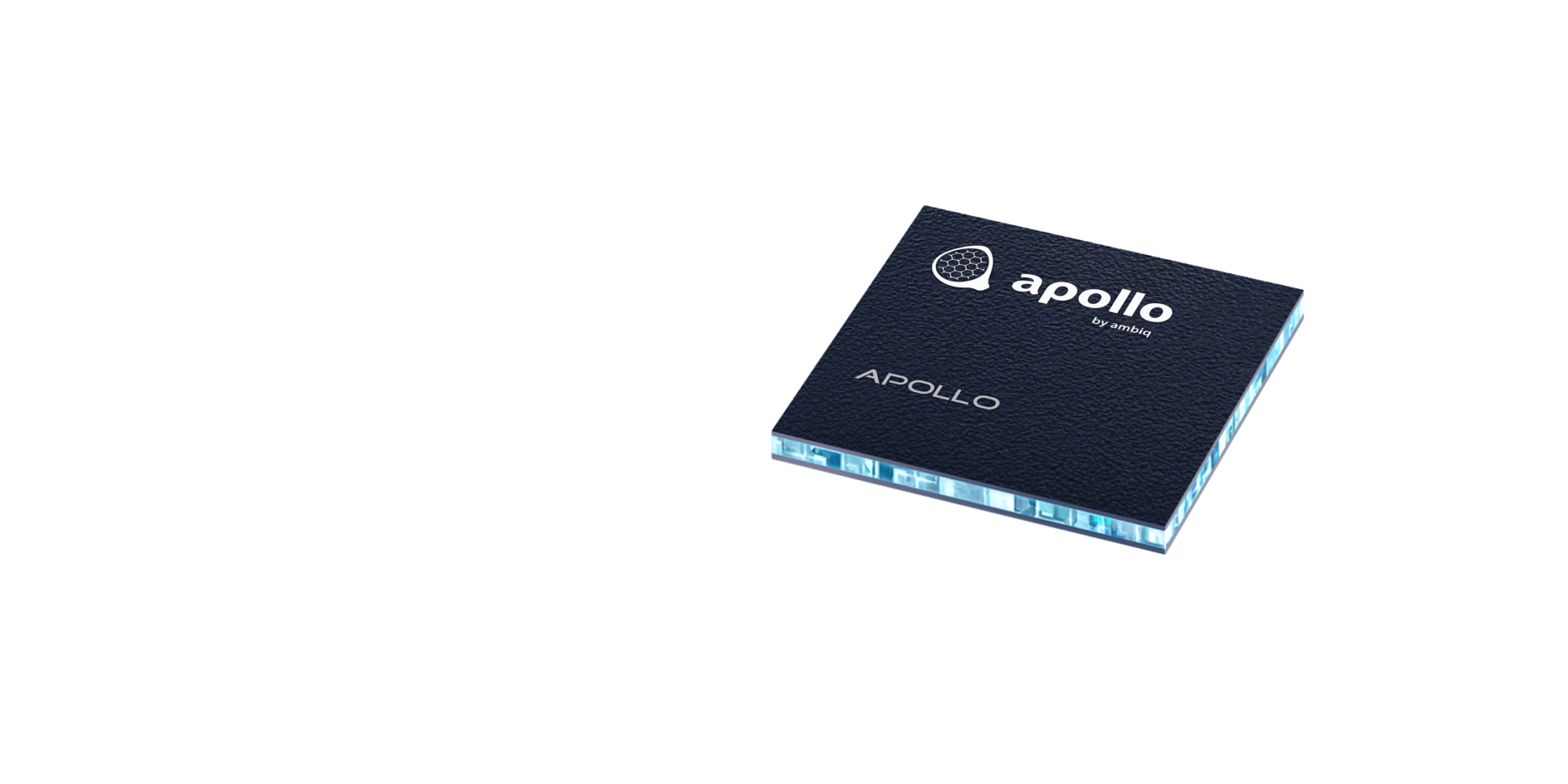
Apollo Ultra-Low Power SoC Platform for IoT Devices

SPOT on a Chip
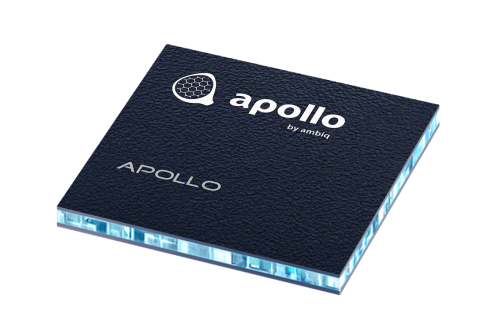
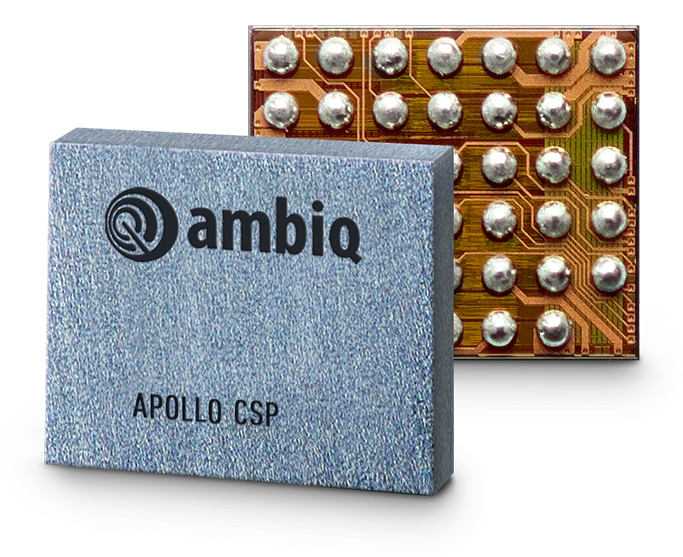
The first generation* of Ambiq’s Apollo SoC introduced the ultra-low power Subthreshold Power Optimized Technology (SPOT®) platform, the first to bring subthreshold technology into mass production, delivering revolutionary battery life for smart devices, including wearables, activity and fitness monitors, and wireless sensors.
*The first-gen Apollo SoC is not recommended for new designs. Apollo2 or Apollo3 instead.
Take Charge of Your Life

01

Extended Battery Life:

The SPOT platform can extend the battery life of devices to last weeks or months.

02

Uniquely Tuned ADC

ADC is uniquely tuned for minimum power with a configurable measurement mode that does not require SoC intervention.

03

High Performance

Implementing the Arm® Cortex®-M4 with FPU provides higher performance and significantly lower power consumption than 8-bit, 16-bit, and other comparable 32-bit cores.

04

Process Sensor Data

Capable of running complex data analysis and sensor fusion algorithms on device.

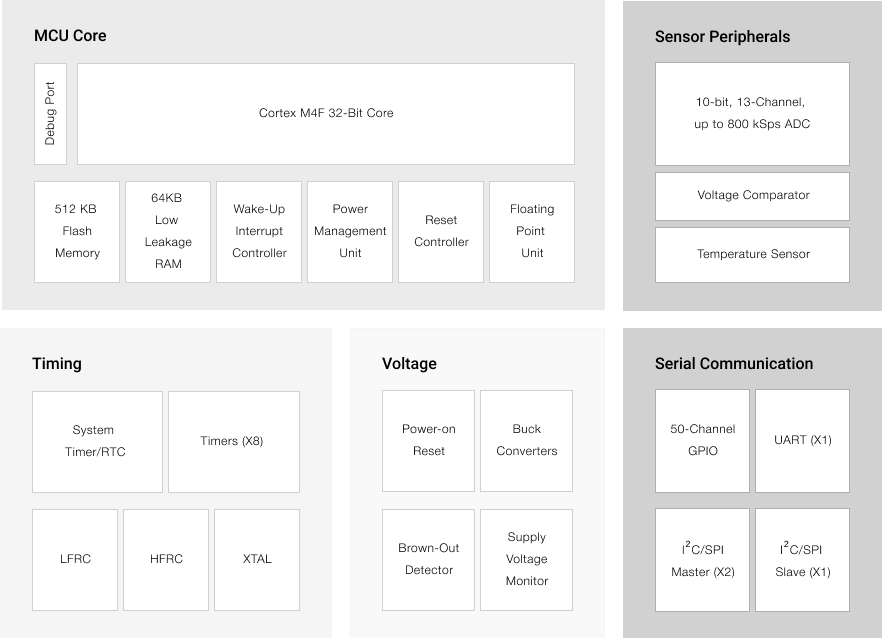
Block Diagram for the Apollo Ultra-Low Power SoC

Block Diagram for the Apollo MCU

Specifications

Ultra-Low Supply Current

  • EEMBC ULP Bench score of 377
  • 35 μA/MHz executing from flash at 3.3 V
  • 143 nA deep sleep mode at 3.3 V
  • 419 nA deep sleep mode with XTAL-assisted RTC at 3.3 V

High-Performance Arm Cortex-M4 Processor

  • Up to 24 MHz clock frequency
  • Floating Point Unit (FPU)
  • Memory Protection Unit (MPU)
  • Wake-up interrupt controller with 12 interrupts

Ultra-low Power Memory

  • Up to 512KB of flash memory for code/data
  • Up to 64KB of low-power RAM for code/data

Ultra-Low Power Interface for On- and Off-Chip Sensors

  • 10-bit, 13-channel up to 800 kSps ADC
  • Up to 800 kSps sampling rate
  • Temperature sensor with ±4°C accuracy

Ultra-Low Power Flexible Serial Peripherals

  • 2xl2C/SPI masters for communication with sensors, radios, and other peripherals
  • 1xl2C/SPI slave for host communications
  • 1x UART for communication with peripherals and legacy devices

Rich Set of Clock Sources

  • 32.768 kHz Crystal (XTAL) oscillators
  • Low Frequency RC (LFRC) oscillator (1.024 kHz)
  • High Frequency RC (HFRC) oscillator (24 MHz
  • RTC based on Ambiq’s AM08X5/18X5 family

Wide Operating Range

  • 1.8-3.8 V, -40°C to 85°C

Applications

  • Wearable electronics
  • Wireless sensors
  • Activity and fitness monitors
  • Consumer medical devices

Package Options

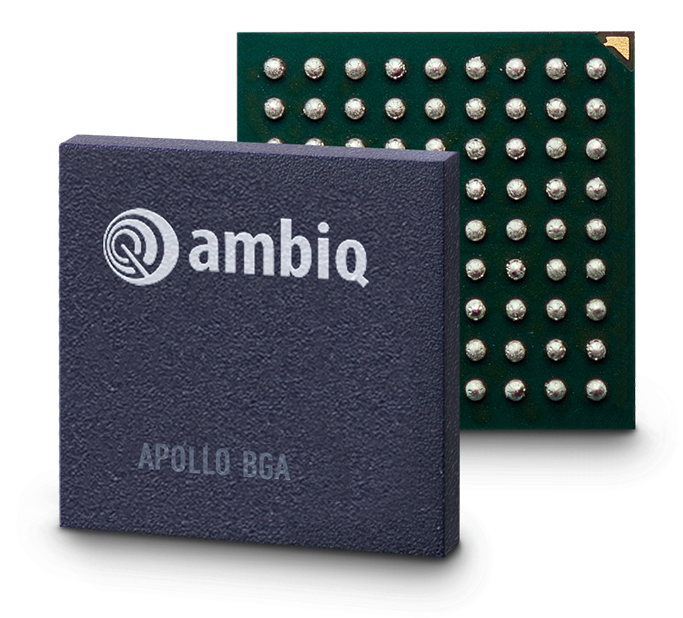
  • 4.5 mm x 4.5 mm 64-pin BGA with 50 GPIO
  • 2.49 mm x 2.90 mm 41-pin WLCSP with 27 GPIO

Ordering Information

  • APOLLO512-KBR (512KB Flash, 64KB RAM, 64-pin BGA)
  • APOLLO512-KCR (512KB Flash, 64KB RAM, 41-pin WLCSP) AMAP1EVB (EVB)

Video Library

Design Resources

Browse our Design Resources which includes product briefs, datasheets, selector guides, family brochures, white papers, quick start guides, and more to help you learn more about products.

Additional Documentation

  • Set favorites
  • Get update notifications
  • Use search filters

Frequently Asked Questions (FAQ)

  • Apollo is a family of ultra-low-power system on chips (SoCs) developed by Ambiq for battery-powered devices such as wearables, IoT sensors, and wireless embedded systems.

  • Apollo processors use the Arm® Corte® x-M4 architecture as well as M55 depending on Apollo generation, providing efficient embedded processing with floating-point support for sensor processing and signal analysis.

  • Apollo SoCs use Ambiq’s SPOT® (Subthreshold Power Optimized Technology) platform, which allows the transistiors to operate at extremely low voltages and reduce power consumption.

  • Apollo SoCs are commonly used in wearables, fitness trackers, smart home devices, industrial sensors, healthcare monitoring systems, and battery-powered IoT devices.

  • Yes. Apollo SoCs include analog and digital sensor interfaces that allow devices to process accelerometer, gyroscope, and other sensor data efficiently.

  • Wearable devices require processors that consume minimal power to extend battery life while maintaining reliable performance for continuous monitoring and data processing.

  • Yes. Apollo SoCs can support lightweight edge AI workloads such as activity recognition, voice commands, and sensor data analytics.

  • Ambiq provides software development kits, documentation, and developer tools to help engineers build applications using the Apollo SoC platform.

Preparing to download